
The Real Reason Your Customer Acquisition Cost (CAC) Is Rising: the 5% illusion.

Updated: 9 hours ago

I’ve had many conversations with founders and CEOs who say, “We need to revisit our positioning.”
The backdrop to the conversation goes something like this: revenue has plateaued, CAC is creeping up, and performance media is being optimised to within an inch of its life. And the conclusion is always the same: “It must be the positioning.”
Sometimes it is. But more often? It isn’t.
More often, the real constraint isn’t what you stand for - It’s whether anyone remembers you when it counts.
The 5% Illusion
Research from the Ehrenberg-Bass Institute consistently shows that:
Only around 5% of your category buyers are “in market” at any one time.
Which means 95% of your future revenue isn’t actively looking for you.
If your growth model relies heavily on performance optimisation, conversion funnels and short-term demand capture, you’re competing for that 5%.
And when you do that long enough, two things happen:
CAC rises
Discounting creeps in
Not because your positioning statement is wrong, but because your brand isn’t mentally available enough to expand beyond the already-converted few.
Rising Customer Acquisition Cost (CAC): Positioning vs Salience
Positioning is what you want to be known for.
Salience is what buyers actually think of when a buying situation arises.
The IPA’s Effectiveness Databank - one of the most robust longitudinal datasets on advertising effectiveness - consistently shows that businesses investing in brand building deliver stronger profit growth and lower volatility over time.
Les Binet and Peter Field’s work in The Long and the Short of It reinforced this: campaigns that balance long-term brand building with short-term performance significantly outperform those focused purely on activation.
And yet, many scaleups - particularly post-Series A - shift heavily toward performance. It makes sense because investors want traction, and dashboards need numbers. Paid media looks measurable.
But over-optimising for the short term weakens the long-term growth engine. And that’s when positioning gets blamed.
The £10m–£50m Inflection Point
This is where we see it most often. At the early stage, founder energy carries the brand, sales are often relationship-led, and the brand narrative is informal but compelling.
As you scale:
The founder can’t be in every pitch
The category becomes more competitive
Teams fragment around channel metrics
Agencies operate in silos
The investor story drifts from the market story
Suddenly, growth begins to feel a little harder.
At this point, it’s tempting to revisit the positioning, but often the fundamentals haven’t changed.
What’s missing is:
Clear category entry points
Distinctive brand assets
Consistent memory structures
A joined-up brand and performance strategy
Organisational alignment behind one commercial story
In other words, brand salience and organisational and operational design.
Signs You Don’t Have a Positioning Problem
You might not have a positioning issue if:
Customer Acquisition Cost (CAC) is rising despite creative refreshes
Discounting is becoming a habit
Performance media is working harder for less
Investors are asking for clearer differentiation
Your sales team tells the story differently to marketing
These are all growth engine problems, and growth engines are built from three things working together:
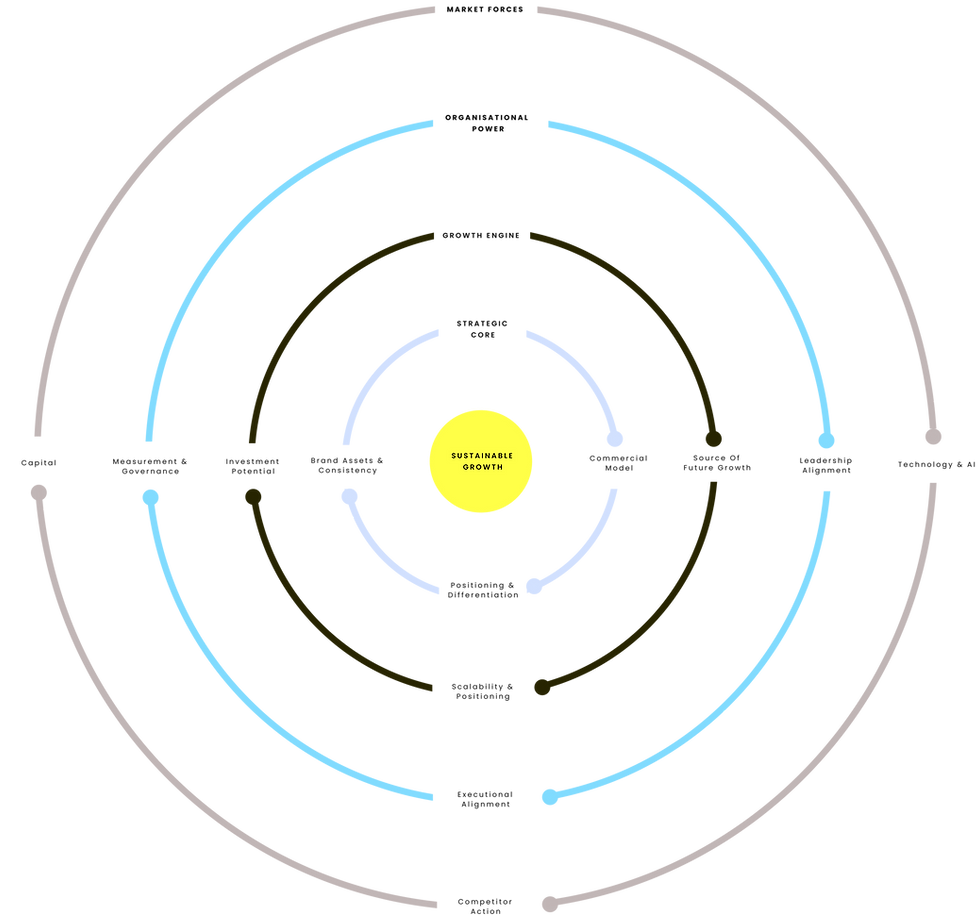
Strategic core (vision, category clarity, positioning)
Growth engine (brand building, demand generation, go-to-market design)
Organisational power (leadership alignment, capability, capital allocation)
If one of these weakens, growth is constrained.
What Fixes It
At OSER, we start with “Where is growth being constrained?"
Is the category definition too narrow?
Are you only targeting the 5% in market?
Have you underinvested in mental availability?
Is your investor narrative disconnected from brand strategy?
Is performance spend crowding out brand building?
Compounding growth happens when a business knows exactly where it plays, why it wins and invests long enough for buyers to remember.
If growth feels harder than it should and you want to stress test where constraint sits - across strategic core, growth engine and organisational power - the OSER Growth Diagnostic gives you a clear, structured view in under ten minutes.
FAQs
What is brand positioning for a scaleup?
For a scaleup, positioning is more than a messaging exercise. It defines the category you’re competing in, the commercial space you want to own, and how you will build mental availability at scale. It should shape product, marketing, sales and investor narrative - not sit in a brand deck.
Why does growth often stall after Series A or B?
Post-Series A, companies often shift heavily into performance marketing to show traction. Without parallel investment in brand building and distinctive assets, they compete for the small percentage of buyers already in market. Over time, this drives rising CAC and margin pressure.
Is performance marketing enough to drive long-term growth?
Evidence from the IPA Effectiveness Databank and Binet & Field shows that businesses balancing long-term brand investment with short-term activation outperform those focused purely on performance. Performance captures demand. Brand creates future demand.
What is the 5% rule in marketing?
The 5% rule, based on Ehrenberg-Bass research, suggests that only a small proportion of category buyers are actively purchasing at any given time. Sustainable growth requires building mental availability with the other 95%, not just competing for the immediate few.
How do investors evaluate brand strength?
Sophisticated investors increasingly look beyond short-term acquisition metrics. They assess category clarity, pricing power, customer retention, brand differentiation and long-term growth resilience. Strong brand systems reduce volatility and support valuation multiples.


