
Why a Scaleup Marketing Strategy Needs TV, VOD and OOH
- Laura Derbyshire

- Dec 10, 2025
- 5 min read
Updated: Dec 16, 2025
A Scaleup Marketing Strategy Built for £3m–£20m Revenue Teams
For £3m–£20m revenue businesses, a scaleup marketing strategy must go beyond paid social and performance channels if growth has plateaued.
For most Series A and B scale-ups, especially digitally native DTC brands, the early years are powered by performance marketing inside the digital “walled gardens.” Meta, TikTok, Google, and programmatic channels deliver the short-term returns that fuel fast early-stage growth.
But every high-growth business eventually hits the same ceiling: increasing CPAs, shrinking attribution clarity, rising competition, and limited reach. To move beyond this plateau, scale-ups increasingly turn to brand-reach channels, including TV, CTV (Connected TV - an internet-delivered television that lets brands run targeted, trackable ads on big-screen streaming platforms), BVOD, and Out-of-Home, to unlock the next stage of profitable scale.
These channels allow founders and marketing teams to shift from short-term optimisation to long-term fame, emotional relevance, trust, and market leadership, which drive sustainable profitability.
Below, we break down the mechanics behind this shift and highlight fresh examples across the UK and US of scale-ups that have successfully moved from digital-only to mass-reach strategies.
The Reality: Digital-Only Growth Has a Ceiling
Performance marketing excels at harvesting demand. But it struggles to create demand at scale.
CPAs rise. Audiences saturate. Algorithms flatten.
Brand-reach channels, however, create new demand pools; driving awareness, credibility, and memory structures that make all digital channels more efficient.
That’s why some of the fastest-growing DTC brands today are blending both worlds.
Recent Scale-Up Examples: Who’s Doing It Well?
1. Athletic Greens (AG1)
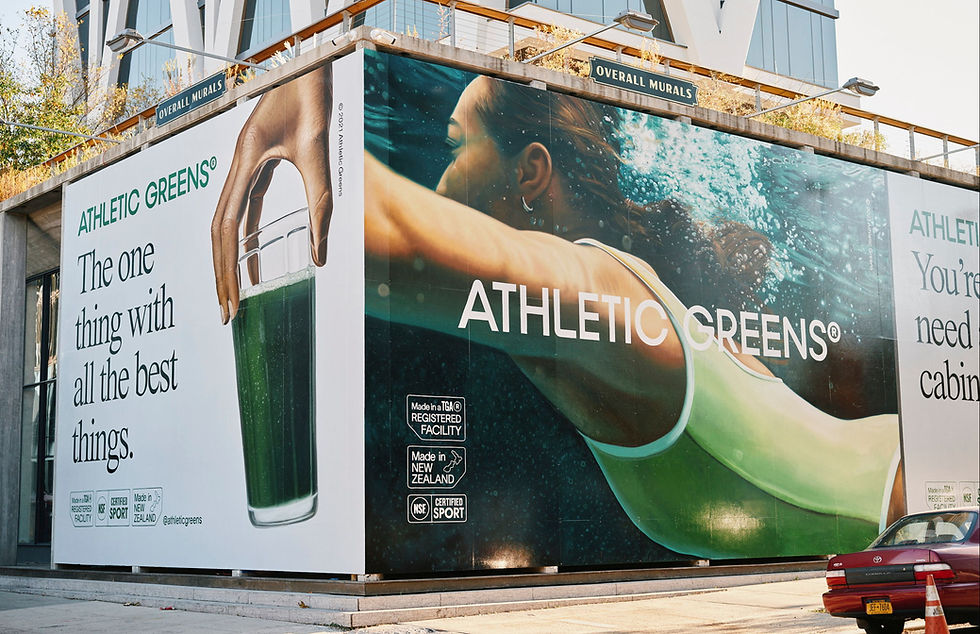
After building early traction through influencers and podcasts, AG1 expanded into Connected TV and OOH across New York, LA, and other major US markets. Now they've crossed the pond with a similar strategy.
The result:
Faster mainstream adoption
Higher assisted conversions
Strengthened trust in a premium health supplement category
AG1’s CTV push played a key role in its journey to becoming a category-defining wellness brand.
2. Huel

Huel grew rapidly online through direct-response ads and social-first brand-building.
When the brand hit its UK performance ceiling, it expanded into:
London Underground OOH
National TV and BVOD
US digital OOH and CTV
This brand reach helped Huel grow internationally and build credibility in a new, still-developing food category.
3. Patch Plants

Patch Plant's early growth came from social and search. Once competition spiked and performance CPAs stalled, the team invested in:
Large-format OOH across London
Targeted DOOH in residential hubs
Cross-channel creative alignment
OOH gave Patch the mass visibility and brand stature needed in a cluttered DTC home category.
4. Butternut Box

The Butternox Box pet-food DTC brand scaled through paid social but unlocked its next growth wave through:
National and regional TV spots
Linear and BVOD combinations
TV brought legitimacy in a market where trust and safety matter, driving customer acquisition at scale.
5. Who Gives A Crap

The sustainable toilet paper brand Who Gives a Crap used:
Tube OOH
Urban DOOH formats
CTV
OOH played a crucial role in reaching eco-conscious urban audiences that performance alone couldn't reach at scale.
6. Bloom & Wild

To differentiate in a crowded DTC gifting space, Bloom & Wild added:
London billboards
National DRTV
Broadcaster VOD
Their campaign helped them move from online-first challenger to one of the UK’s best-known gifting brands.
The Mechanics: Why Brand Channels Accelerate Profit
Scale-ups shifting into brand-reach channels experience three major effects:
1. Amplification
Research consistently shows:
TV increases paid social performance by 31%
TV increases its own effectiveness by 35% when paired with OOH
Brand channels make every existing performance pound work harder.
2. Higher Saturation Points
Digital channels saturate fast.TV and OOH saturate slowly.
Advertisers can typically invest:
3x more in TV than print
8x more than online video
Before hitting diminishing returns, for scale-ups, this means one thing: room to grow.
3. Performance Priming
Brand exposure increases:
Search volume
Click-through rates
Conversion rates
Customer trust
In other words: Brand campaigns don’t replace performance. They supercharge it.
4. Budget Allocation: The 60:40 Rule
Les Binet and Peter Field’s research suggests long-term growth is maximised when brands allocate:
60% to brand building
40% to performance
For Series A/B companies, this may initially skew closer to 70:30 or 50:50 depending on cost of acquisition, category, and growth velocity, but the underlying principle holds: allocate resource to both creating and capturing demand.
Channel-by-Channel: What They Deliver for Scale-Ups
Channel | Primary Scaling Benefit |
Linear TV | Highest saturation point; drives 46.6% of all advertising-driven profit. |
BVOD / VOD / CTV | Premium environment; reaches cord-cutting younger audiences; strong profit returns. |
OOH / DOOH | Amplifier for all other media; builds trust for online-first brands; strong ROI. |
Actionable Next Steps for Scale-Ups
(What to Do Now)
1. Identify Your “Reach Gaps”
Tools like dunnhumby Sphere help scale-ups understand which audiences they’re not reaching and where brand-reach channels can fill those gaps.
\
2. Explore Affordable DOOH Activation
Platforms like LMX.ai offer transparent planning and low-friction digital OOH buying, which is ideal for Series A/B budgets.
3. Pilot CTV
US and UK CTV offers a cost-effective step into TV-like environments before committing to linear.
4. Build a Brand Narrative Worth Amplifying
Before scaling mass reach, ensure a clear:
Value proposition
Memory structure
Creative platform
Emotion-led story
Otherwise, mass reach amplifies noise, not growth.
5. Align Brand + Performance Under One Strategy
Brand teams and performance teams should not operate in silos. The most successful scale-ups integrate both into one growth system.
The Importance of Brand Reach In Becoming A Category Leader
Scale-ups that rely solely on digital performance eventually stall. Scale-ups that expand into TV, VOD, and OOH grow bigger, faster and with more predictable profitability.
Brand reach isn’t a “nice to have.” It’s the differentiator between a digital-first challenger and a category leader.
Big-Agency Effectiveness, Now for ScaleUps

OSER is now partnering with Diego Chicharro, former Head of Effectiveness and Head of Strategy at Publicis, who has led strategy for some of the UK’s biggest and most complex brands, including Morrisons, P&O Ferries, Taco Bell, and others.
Laura and Diego previously worked together on the Haribo account, and together they’re bringing this level of big-agency strategic thinking, effectiveness modelling, and brand-growth planning to scale-ups that are ready to move beyond performance-only marketing and unlock mass-market reach.
Book a Growth call with Laura and Diego.


